Many of the spy novelists whose works I’ve enjoyed cite Ian Fleming, John le Carré, or Len Deighton as their primary inspiration. John Buchan also gets an honourable mention from time to time, along with Graham Greene.
However, for my money, Raymond Chandler deserves top billing – even though his characters are too busy paying the rent or making ends meet to worry about global conspiracies and arch-villains. The people in Chandler’s novels and short stories are often trapped in a web of lies and deceit, walking a fine line between what’s legal and what’s right in order to get to the truth. Although Chandler’s Philip Marlowe was a gumshoe, I’d like to think that he and my down-at-heel British spy, Thomas Bladen, would find they had a lot in common if they happened to meet in an empty bar.
A cinematic influence
Alongside Raymond Chandler, I also owe a huge debt to cinema so it’s my great pleasure to introduce you to a back catalogue of films that remain classics of the spy / thriller genre. Many of them are derived from novels but for consistency I will only reference the films and I’ve added some IMDB links so you can read more about the plot and central characters if the mood takes you. I hope you find some old favourites here, as well as some ‘new’ classics to add to your own list.
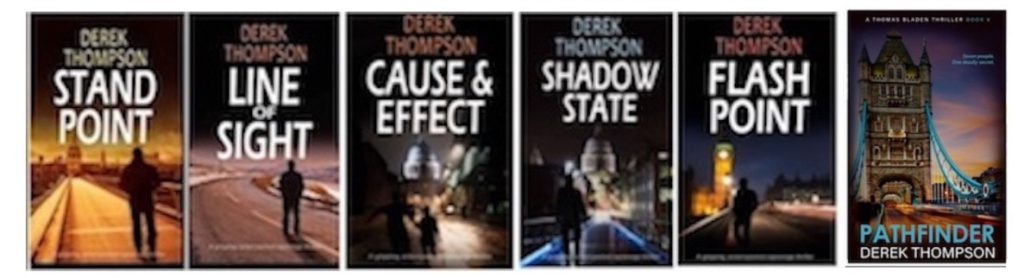
We will come back to Raymond Chandler in a bit. First and foremost, I have to pay tribute to John Buchan’s The 39 Steps – a tale of a man unwittingly drawn into a murderous conspiracy, who goes on the run to prove his innocence. I favour the 1935 original starring Robert Donat and Madeleine Carroll, as well as a brilliant BBC version from 2008 (which includes elements from the novel that were left out of other films). How much do I love The 39 Steps? Well, in Standpoint, Thomas watches the 1935 version with Miranda and comments on how Hitchcock changed the story from the novel. There’s also a homage to one of the film’s plot devices in Line of Sight, my follow-up to Standpoint, but that’s another story.
North by Northwest (1959) is another great brilliant example of a mistaken identity driving the plot forward. How do you win through when you don’t know what you’re supposed to know? I think it helps to have other people looking out for you from time to time.
The films Farewell My Lovely (1944), The Big Sleep (1946) and The Long Goodbye (1973) allow Raymond Chandler’s world-weary private detective, Philip Marlowe, to fill the screen; much like Bogart’s performance as Sam Spade in the Dashiell Hammett co-scripted adaptation of The Maltese Falcon.
My original intention had been to write Thomas Bladen as a detective, only he arrived pretty much fully formed and had his own opinions about what he did for a living!
What I love most about this batch of films is the dialogue and the characterisation. The plots are well-crafted but to me they are secondary. The ‘hero’ is flawed and his attitude is often more of a hindrance than a help as he battles relentlessly against the status quo. These films are gritty, sometimes sleazy and show the underbelly of society. Yet somehow, almost miraculously, the hero emerges with most of his honour intact.
My fondness for this genre led to the creation of a secondary character who appears in a couple of the Bladen stories: Leon Thurston, a West Indian private detective who plies his trade from an old minicab office in Dalston, East London.
Speaking of Raymond Chandler, make time for The Blue Dahlia (1947) – it’s an intriguing whodunit that apparently involved a controversial rewritten ending…but you can research that for yourself! Like Alan Ladd’s Johnny Morrison, my protagonist Thomas Bladen is out of step with the world around him, but the right woman at his side makes all the difference.
Vicious Circle (1957) finds a humble doctor (albeit with a cravat!) drawn into a deadly game of blackmail and intrigue. I’d put that film in the same category as The Man Who Knew Too Much (1934) and (1956). Ordinary people in extraordinary times, who dig deep when they find themselves pawns in a much bigger game – much as Robert Hannay did in The 39 Steps.
Both The Conversation (1974) and Enemy of the State (1998) tackle surveillance, paranoia and ethics, along with the perennial question of who watches the watchers. It is perennial too, as that phrase is as old as the Romans. In Thomas Bladen’s world, a simple surveillance job often turns out to be much more involved, especially when he asks some difficult questions (not that it stops him).
In the world of espionage, even though an observer may seem impartial they cannot deny that there are consequences to their work. Three Days of the Condor (1975) pits one man against the ‘organisation’ when tragedy strikes, trying to stay one step ahead in order to hold people in power accountable.
By book five (Flashpoint) in my spy series, Thomas has learned that justice can take many forms and sometimes even a bitter compromise is the best option. That realisation takes a darker turn in the sixth book (Pathfinder).
Still looking for a classic spy film? I give you The Third Man (1949), which involves a mystery, a disappearing act with a difference and a conspiracy: how do you discover the truth when everyone is telling you something different? Its cunning and amoral titular character (a compelling turn from Orson Welles) dominates the film despite even when he’s not on the screen.
This group of films illustrate another element that I wanted to bring to my books – unresolved endings – where the viewer is left to wonder what could happen afterwards. That’s how I’d like to leave my readers.
I hope you’ll make time to watch at least some of these films, even if you’ve seen them before.
For those who enjoy extra homework, make time for:
The Long Memory (1953), Rear Window (1954), A Prize of Arms (1962), Gilda (1946), Build My Gallows High (1946), and In a Lonely Place (1946).
Leave a Reply